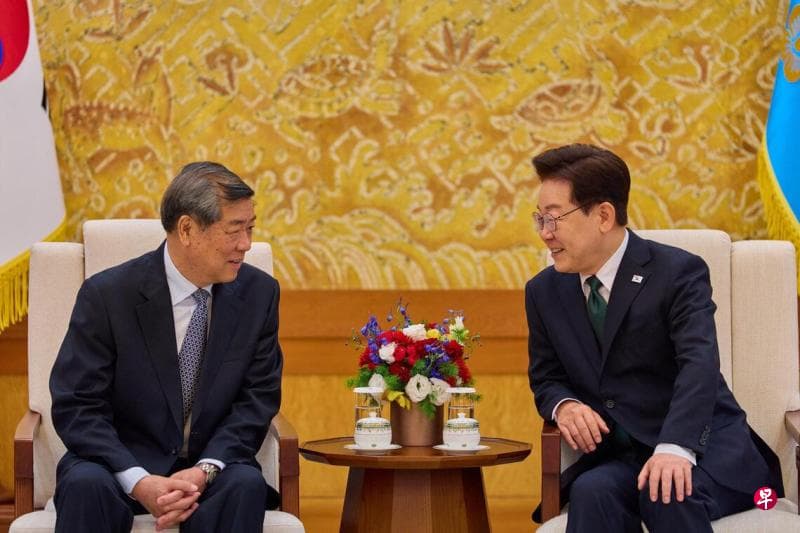
On Wednesday (May 13), ahead of the US-China summit, South Korean President Lee Jae-min met with Chinese Vice Premier He Lifeng and US Treasury Secretary Bessenter, who were visiting Seoul. Lee emphasized supply chain and economic security cooperation to the US side, while stressing to the Chinese side the importance of expanding pragmatic cooperation and stabilizing bilateral relations, demonstrating his commitment to "practical diplomacy" between the US and China.
Lee Jae-myung first met with He Lifeng at the Blue House. The two sides exchanged views on strengthening South Korea-China cooperation, expanding economic and trade exchanges, and establishing a more stable cooperation mechanism. They also decided to continue communication in the fields of industry, trade, and culture to promote more practical results.
Lee Jae-myung stated that maintaining a stable relationship between the US and China will contribute to global development and prosperity, including in South Korea, and that South Korea will fully support the smooth progress of US-China negotiations. He also emphasized that South Korea and China have fully restored bilateral relations through the summit visits last year and this year, which is one of the achievements of South Korea's "practical diplomacy centered on national interests." Both sides should adapt to changes in the international environment, further expand cooperation, and contribute to the well-being of the people of both countries.
He Lifeng stated that the completion of the relevant trade negotiations in South Korea before the US-China summit in Beijing on the 14th was of profound significance, and expressed his gratitude to the South Korean government for its active support of the US-China trade consultations. He also said that under the strategic guidance of the leaders of both countries, trade between South Korea and China continued to grow in the first half of this year, following last year's growth, and South Korea-China relations maintained a good momentum of development.
Subsequently, during his meeting with Bessant, Lee Jae-myung emphasized that South Korea and the United States should further strengthen economic and technological cooperation, and enhance collaboration in areas such as core mineral supply chains and foreign exchange markets. He reiterated that South Korea will continue to fulfill its investment commitments to the United States and expressed hope that both sides will expand cooperation in strategic investment and economic security based on solid mutual trust.
Bessenter agreed, stating that it is necessary for South Korea and the United States to further strengthen their cooperative relationship. He also noted that, amidst a complex international environment including the situation in the Middle East, South Korea, under Lee Jae-myung's leadership, has achieved remarkable results in areas such as economic growth and stock market performance.
South Korean media pointed out that the North Korean nuclear issue was not listed as a core topic in the public agenda of the US-China summit, raising concerns in the international community about North Korea's "de facto nuclearization" trend.
Analysts believe that if the US policy toward North Korea shifts from "promoting denuclearization" to "managing the nuclear threat," North Korean leader Kim Jong-un's "nuclear strategy" may be implicitly accepted, and South Korea's role in the Korean Peninsula issue may be weakened.
Victor Cha, a South Korea expert at the Center for Strategic and International Studies (CSIS), recently stated that the United States has long regarded "complete, verifiable, and irreversible denuclearization (CVID)" as the core of its North Korea policy, but the approach of "using sanctions to promote denuclearization" is considered to have limited effectiveness. The Diplomat magazine also pointed out that regardless of how the United States defines it, North Korea's nuclear weapons already exist.